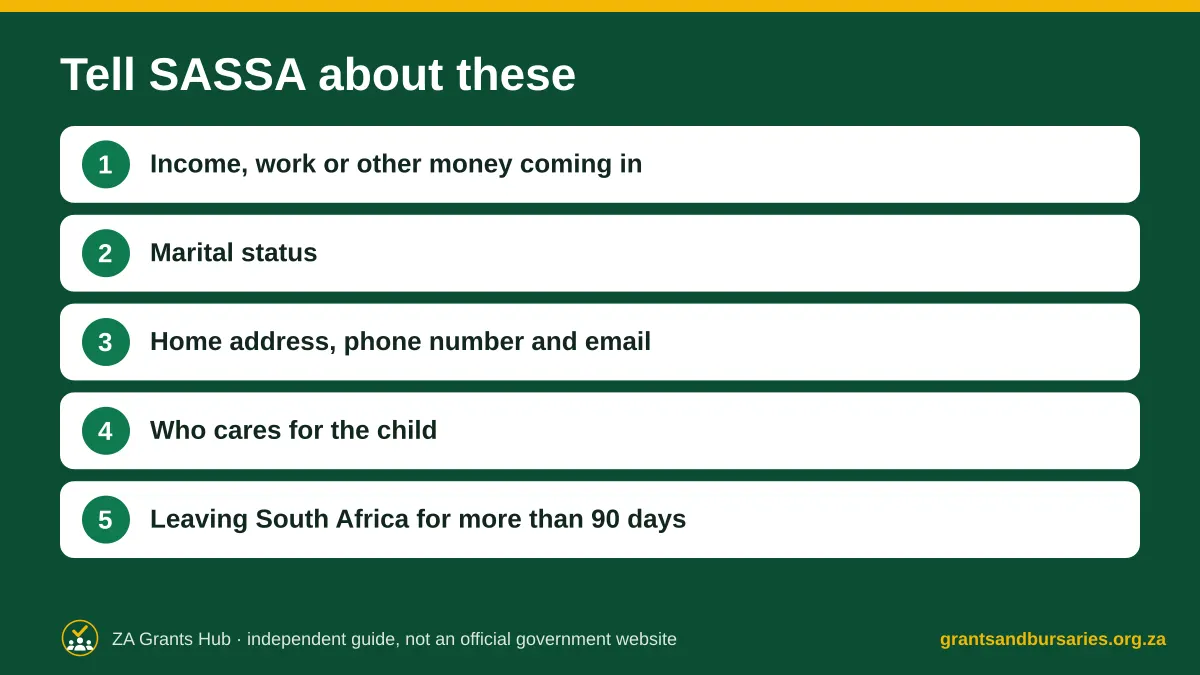
The main changes to report to SASSA are changes to your money, work, marital status, address, contact details and a child's care. You must also speak up before a long stay outside South Africa. Report each change as soon as reasonably possible, at a SASSA office or through services.sassa.gov.za. Keep proof of the date.

Contents (16 topics)
- Which changes must you report to SASSA?
- Why does it matter if you stay quiet?
- How do you report a change to SASSA?
- What if your income or job changes?
- What if you get married, divorced or widowed?
- What must you do when you move house or province?
- How do you change your phone number or bank details?
- What if a child's care changes?
- What happens to your grant during a hospital or institution stay?
- Can you keep your grant if you live or travel abroad?
- What should you take if you cannot get every document?
- What else should you tell SASSA about?
- What should you do if the update does not work?
- Tips for reporting changes without trouble
- Frequently Asked Questions
- Your next step
Which changes must you report to SASSA?
Report anything that changes the facts you gave when you applied. The Social Assistance Act says information that materially changes must reach SASSA as soon as is reasonably possible.
SASSA's 2026 grant booklet tells beneficiaries to come forward on their own. Do not wait for a review notice.
| Change | Why SASSA needs it | Proof to take |
|---|---|---|
| New job, pay rise or other income | Means test grants depend on income | Payslip, appointment letter, bank statements |
| Job ended or income dropped | Your amount may need to change | Termination letter or recent statements |
| Marriage, divorce or death of a spouse | A spouse can count in the means test | Marriage certificate, divorce decree or death certificate |
| New home or postal address | Notices and checks must reach you | Utility bill, or a landlord, chief or councillor letter |
| New phone number or email | SASSA sends messages there | Your ID and the new details |
| New bank account | Payment could fail | Recent statement or bank confirmation letter |
| Child moved to another caregiver | The child grant follows care | Birth certificate and details of the new arrangement |
| Long absence from South Africa | Payment can be suspended | Travel dates and supporting proof |
| Admission to a state care institution | The grant may change or end | Admission and discharge papers |
The proof column is a practical guide. SASSA can ask for other documents.
Why does it matter if you stay quiet?
Silence can cost you the grant and leave you with a debt. SASSA warned in November 2026 that it may recover money paid to people who no longer qualified and did not disclose changes.
The same statement said a change does not automatically cancel a grant. SASSA first checks whether you still qualify. Speaking up early therefore limits the damage.
There is also a legal side. A beneficiary who knowingly fails to report a material change commits an offence under the Act. If you have already received money you should not have, read our guide to SASSA grant overpayments.
How do you report a change to SASSA?
A visit to a local office gives you the clearest proof. You can also ask about online options and contact SASSA by phone or email first.
- Name the change. Write one sentence saying what changed and on which date.
- Gather proof. Take your ID and the documents that match your change.
- Choose a channel. Visit an office, or start at services.sassa.gov.za where your task is offered.
- Declare the change. Give the same facts you would put in writing.
- Get a reference. Ask for a stamp, receipt or reference number.
- Ask what happens next. Find out whether your amount or payment date will be affected.
- Follow up. Phone 0800 60 10 11 if you hear nothing before the next pay date.
Find your nearest branch in our SASSA offices guide. The Online services portal guide explains what you can do from a phone or computer.
Warning: SASSA will not ask for your PIN. Do not share it, or a one-time PIN, with anyone who offers to update your record.
Which channel suits which change?
| Channel | Best for | Watch out for |
|---|---|---|
| SASSA local office | Marriage, care changes, long absence, most documents | Queues; take certified copies |
| services.sassa.gov.za | Online tasks the site offers | Not every change can be done here |
| 0800 60 10 11 | Asking what to bring and following up | A call alone may not update your record |
| [email protected] | Leaving a written trail | Do not send your PIN or card details |
| srd.sassa.gov.za | SRD phone number and banking updates | Use only the official address |
Our advice is to use the office for anything that needs proof, then keep your stamped copy.
What if your income or job changes?
Report new work, new pay and any other regular money. Older person, disability, care dependency and child support grants all use a means test.
Tell SASSA when you:
- Start full-time, part-time or self-employed work.
- Get a higher salary or a second income.
- Start receiving a pension, maintenance or rental income.
- Lose your job or earn less.
- Receive a large payment, such as an inheritance or policy payout.
Not every deposit is income. A transfer between your own accounts differs from wages. Keep slips and notes that show where money came from. Our pages on the SASSA means test and Income verification explain how checks work.
If your grant must go down because your finances changed and you reported it, the regulations apply the decrease from the first day of the next month after the change. SASSA must tell you the reasons. If you apply for an increase and SASSA agrees, it applies from the date you applied.
What if you get married, divorced or widowed?
Report every change in marital status. Your spouse's income and assets can count when SASSA works out whether you qualify.
Take the certificate or decree that proves the change. If you were deserted, the SASSA booklet mentions an affidavit. If your spouse died, also read our steps on Reporting a death to SASSA, especially if that person received a grant.
What must you do when you move house or province?
Give SASSA your new address, even if your grant keeps arriving. Moving does not by itself mean you need a new application.
- Collect proof of your new address.
- Visit a SASSA office near your new home.
- Say that you already receive a grant and have moved.
- Update your address, phone number and email together.
- Ask whether your file needs any further step.
- Confirm your payment method, especially if you used a nearby cash point.
Do not file a second application unless SASSA tells you to. Duplicate records can slow everything down.
What if a review notice went to your old home?
Contact SASSA at once and explain when you moved. Missing a review can lead to suspension. See our guide to the Grant review process and how to Check your review status.
How do you change your phone number or bank details?
Handle these early, because both affect whether you get messages and money.
For a permanent grant, ask SASSA how to update your contact details and banking. The booklet says the payment account must be active and in the applicant's name, with a recent three-month statement.
SRD R370 uses its own online process. Follow our guides to Change your SRD cellphone number and Change your SRD banking details. For a child grant account, see Changing child grant banking details.
What if a child's care changes?
Tell SASSA when the child no longer lives with you or someone else takes over the care. A child support grant lapses when the child is no longer in the custody of the primary caregiver.
The new caregiver should apply in their own name. They should not borrow your card or collect your payment. Report these events too:
- The child dies.
- The child moves into a state-funded institution.
- You can no longer care for the child.
- Another person claims to be the primary caregiver.
Our guide on When the child grant stops covers each case. Relatives caring for orphans can also ask about the Child grant top-up.
What happens to your grant during a hospital or institution stay?
A short stay in a normal hospital ward is different from being cared for and maintained by a state institution. Tell SASSA about any long admission so it can apply the correct rule.
The 2022 regulations contain these rules:
| Situation | What the regulations say |
|---|---|
| Older person, disability or war veteran's grant, maintained in a state-funded care institution | Reduced to 25% of the maximum from the fourth month after the month of admission |
| Discharge from that institution | The reduced grant must be reinstated immediately |
| Temporary admission to a psychiatric hospital | The grant lapses six months after admission if the person is still there |
| Care dependency grant, child in a state-funded institution | Lapses on the first day of the seventh month after admission |
| Grant-in-aid | Not payable to a person maintained in a state-funded institution |
The lapsing regulation also names admission to a state-funded institution as a reason for adult grants to end. It sits beside the reduction rule above. Because of this, ask SASSA in writing which rule applies to your admission.
Take the admission date, the name of the facility and any discharge letter. A family member can ask SASSA what is needed if you cannot attend. Read more about Grant-in-aid and the Care dependency grant.
Can you keep your grant if you live or travel abroad?
Not for long, as a rule. If you intend to be outside South Africa for more than 90 days, you must tell SASSA before you leave.
The Act says SASSA must then suspend payment, subject to exceptions. Payment resumes only after you or your procurator appears in person and confirms that you returned permanently.
SASSA may agree to continue payment in set circumstances after a written request. Do not assume it will.
What if an emergency keeps you abroad?
Send SASSA an affidavit or affirmation as soon as the emergency arises. It applies to medical, safety and family emergencies. Include:
- The date you left South Africa and where you are.
- Details of the emergency, with proof.
- The date you plan to return.
- An address where you can be reached.
A person acting for you may submit it. SASSA then decides whether to keep paying and on what conditions.
What if you did not tell SASSA?
SASSA may suspend the grant immediately and recover payments for the period beyond 90 days. It must inform you of the suspension. You then have 90 days to explain why you did not report the absence.
A procurator has duties too. Our Procurator guide explains the role.
What should you take if you cannot get every document?
Go anyway and report the change, then ask which papers can follow later. Waiting for one document can make a small problem bigger.
| Missing item | What you can try | What to ask SASSA |
|---|---|---|
| Proof of address | A letter from a landlord, chief or councillor | How recent it must be |
| Payslip for new work | An appointment letter from the employer | Whether bank statements will help |
| Divorce decree | Request a copy from the court that granted it | Whether a receipt for the request is enough for now |
| ID document | Apply at Home Affairs and keep the slip | Which other identification is accepted |
Write the official's answer on your copy of the form. If someone tells you to come back, ask for a date and a list. This saves a second wasted trip.
Can SASSA ask for proof years later?
Yes. A review can look at your circumstances long after approval. SASSA's booklet lists items such as three months of bank statements for all active accounts, proof of earnings and proof of residence. Keep a folder with your statements, certificates and receipts. Add to it each time something changes, so that you are never starting from nothing.
What else should you tell SASSA about?
Report health, status and identity changes that affect your grant.
- A temporary disability that improves or becomes long term.
- A new ID number from Home Affairs, with the old one.
- A change in refugee status or permit validity.
- A procurator you want to remove or replace.
SASSA also asks beneficiaries to submit a life certificate each year when requested. See Proof of life problems if a check fails. To end an appointment, follow How to remove a procurator.
What should you do if the update does not work?
Go back with your proof and reference number. Most problems come from missing documents or details that do not match.
- Office cannot find your visit: show your stamped copy and the date.
- Online site fails: try later, or report the change in person.
- Payment stopped after your update: ask for the written reason and check How to restore a suspended grant.
- Bank change still pending: see Banking pending or payment failed.
- You disagree with a decision: ask about the appeal route and its 90-day time limit.
- Poor service: use the Complaint steps.
Tips for reporting changes without trouble
A few habits make each update faster.
- Report one list. Mention every change in the same visit so records match.
- Date everything. Write down when the change happened and when you reported it.
- Copy first. Keep copies of every document before you hand it over.
- Certify copies. Ask which copies must be certified before you travel.
- Keep SMS messages. Do not delete notices from SASSA.
- Check the next payment. Compare the amount and date after your update.
- Plan travel early. Speak to SASSA well before a long trip abroad.
- Use official channels. Ignore social media accounts that offer to update records for a fee.
- Tell family where papers are. Someone should be able to act if you are admitted to hospital.
Frequently Asked Questions
What changes must I report to SASSA?
Report changes in income, assets, work, marital status, address, phone number, email, banking and child care arrangements. Also report a planned absence of more than 90 days and admission to a state care institution. The Act expects material changes as soon as reasonably possible, so do not wait for a review.
How soon must I report a change?
The Social Assistance Act says as soon as is reasonably possible after the change. It does not give one fixed number of days for every change. A long absence is different, because you must tell SASSA before you leave. Report quickly and keep a dated receipt to show when you did it.
Can I report a change by phone?
You can phone 0800 60 10 11 to ask what is needed and to follow up. Some changes need documents, signatures or identity checks that a call cannot complete. Ask the agent whether your change is recorded by phone. If not, visit a SASSA office and get a reference number.
Will my grant stop if I get a job?
Not automatically. SASSA must check whether you still meet the rules for your grant, including the income and asset limits. Your amount could stay the same, reduce or end. Reporting early helps you avoid money you must repay. Take your appointment letter and your first payslip when you have it.
Do I need to reapply after moving to another province?
Moving alone does not usually mean a new application. Give SASSA your new address and contact details at an office near you, and say you already receive a grant. Ask whether anything else is needed for your grant type. Only submit a new application if an official tells you to do that.
How long can I stay outside South Africa?
If you intend to be away for more than 90 days, tell SASSA before leaving. Payment is generally suspended for such an absence. Medical, safety or family emergencies have a special process with an affidavit and proof. Shorter trips can still lead to identity checks, so keep your records and phone number current.
Does a hospital stay affect an old age grant?
An ordinary short hospital stay differs from being maintained in a state care institution. For the latter, the regulations provide for a reduction to 25% from the fourth month after the month of admission. They also list admission as a lapsing event. Ask SASSA to confirm which applies to you.
What if I forgot to report a change last year?
Report it now with the dates and proof. SASSA may reassess your grant and may seek to recover money you were not entitled to receive. Coming forward is better than being found out at a review. Ask for the calculation in writing and ask about repayment arrangements if there is a debt.
Do SRD recipients have to report changes?
Keep your SRD details accurate, especially your phone number and bank account. SRD eligibility is checked against income and other records, and wrong details can cause a decline or a failed payment. Use only srd.sassa.gov.za for updates. If your situation changed and you no longer qualify, contact SASSA.
Can a family member report a change for me?
They can ask SASSA what is required and may help you gather papers. To act formally for you, SASSA may require a procurator appointment. In an emergency abroad, the Act allows someone acting in your interest to submit the statement. Never give a helper your PIN or let them keep your card.
Your next step
Write down every change since your last SASSA visit, with its date. Take that list, your ID and your proof to a SASSA office, and leave with a reference number.
Sources
- Social Assistance Act 13 of 2004
- Social Assistance Regulations, 31 May 2022 (Government Notice R2119)
- SASSA booklet: You and Your Grant 2026
- EWN: SASSA on reporting eligibility changes, 13 November 2026

About The Author
Sarah Johnson is an informational writer covering South African social assistance programmes, SASSA grants and public service updates.
Keep Reading