A SASSA grant overpayment is money paid to you that you were not entitled to receive, and the law treats it as owed to the State. There is an important exception: the Act provides for the debt to be remitted if you show you did not know. Ask for the details in writing before you agree to anything.

Contents (13 topics)
- What is a SASSA grant overpayment?
- Why do overpayments happen?
- Do you have to repay a SASSA overpayment?
- Can the debt be written off if you did not know?
- What should you do when you get a notice?
- How can you dispute the amount or the decision?
- Can you repay in instalments?
- What if you notice extra money yourself?
- What happens if you ignore it?
- What if the money was paid to someone who died?
- Tips for handling a grant debt
- Frequently Asked Questions
- Your best next step
What is a SASSA grant overpayment?
It is any grant money paid when you did not qualify for it, in full or in part. SASSA may have believed you were entitled when it paid.
It differs from other money problems:
- A double or extra deposit that you notice yourself.
- Months paid after your circumstances changed.
- A higher amount than your income allowed.
- Payments for a child who left your care or turned 18.
- Money paid after a beneficiary died.
Back pay is not an overpayment. If a larger amount arrives for missed months, check our SRD back pay guide first.
Why do overpayments happen?
Most start with information that is out of date. Some start with a mistake by the agency or a bank.
| Cause | Example | What to gather |
|---|---|---|
| Income not updated | You started work and payments continued | Appointment letter and payslips |
| Care changed | The child moved to another household | Dates and proof of the move |
| Death reported late | Money arrived for later months | Death certificate and statements |
| Long absence abroad | More than 90 days outside the country | Passport stamps and notices to SASSA |
| Approval in error | The grant should not have been awarded | Your original application receipt |
| Wrong amount calculated | Records show the wrong income | Statements and your declarations |
Reporting early prevents most of these. See the Changes you must report to SASSA.
Do you have to repay a SASSA overpayment?
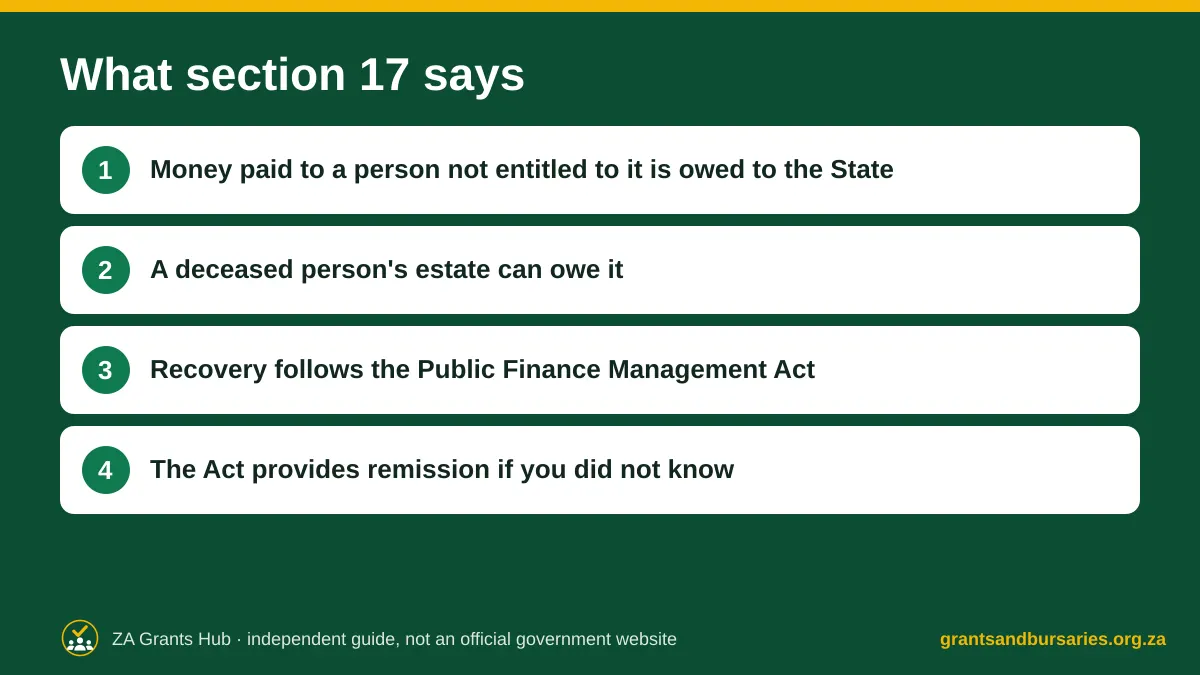
Often yes, but not in every case. Section 17(1) of the Social Assistance Act says money paid to a person who was not entitled to it is due and payable to the State.
If that person has died, the estate can owe it. Section 17(2) says SASSA must recover it under the Public Finance Management Act. In November 2026, SASSA repeated that it may recover money unduly paid where changes were not disclosed.
A notice is still a claim that you can check. Dates and amounts can be wrong.
Can the debt be written off if you did not know?
The Act has a specific protection. Section 17(3), as published in 2004, says the Minister shall remit the amount if you satisfy the Minister that you received it without knowing you were not entitled.
Two points matter. First, you carry the task of showing what you knew. Second, remission is not automatic.
Ask SASSA how to apply for remission and check whether the process has changed since the Act was published. Put your request in writing and include:
- Which payments you are asking about.
- Why you believed you were entitled to them.
- What you told SASSA, and when.
- Any letter or message that led you to believe it.
- Your current income and household situation.
Be truthful. A false statement can lead to criminal charges.
What should you do when you get a notice?
Act promptly and stay calm.
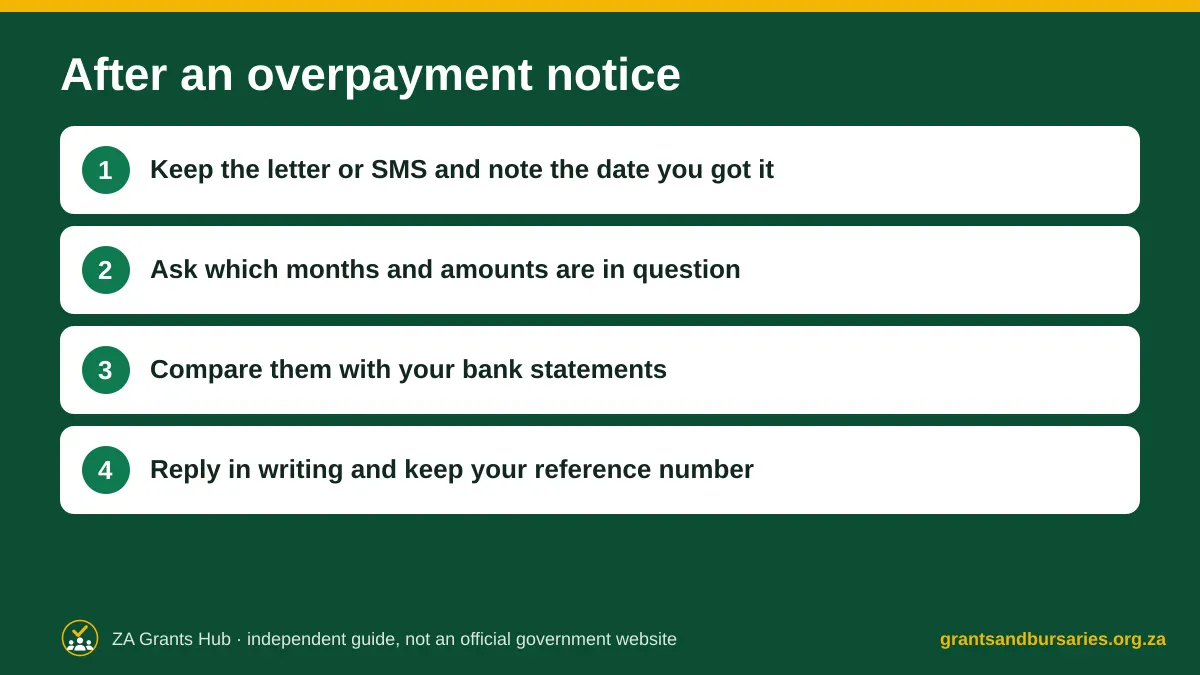
- Keep the notice and write down the date you received it.
- Confirm it is genuine by phoning 0800 60 10 11 or visiting a SASSA office.
- Ask for a written breakdown of months, amounts and the reason.
- Collect your statements and your proof of what you reported.
- Compare each month and mark anything you dispute.
- Reply in writing before any date stated in the notice.
- Ask about remission, appeal or repayment, depending on your facts.
- Keep every reference number in one file.
Warning: Never pay an SRD or grant debt into a private account or give cash to a person who phones you. Confirm payment details at a SASSA office.
How can you dispute the amount or the decision?
Challenge the facts in writing and attach proof. Say exactly which month or figure is wrong.
If SASSA plans to suspend or cancel your grant, the regulations generally require 30 days' notice. The notice should give the date, the reasons and your right to make representations. Cases of fraud or misrepresentation are treated differently.
For an appeal against a decision on your grant, the usual limit is 90 days from when you learn of it. The SASSA booklet lists [email protected] for normal grants. A late appeal needs reasons, so act early. A legal advice office or Legal Aid South Africa can help you decide which route applies to a debt.
Can you repay in instalments?
SASSA has said publicly that its debtors policy allows different repayment periods. Someone who cannot afford the standard period can ask for more time, which needs approval.
Ask at a SASSA office for an arrangement. Take proof of income and essential costs. Before you sign:
- Check the total and the instalment.
- Ask whether any interest applies.
- Ask how and where to pay.
- Request a copy of the agreement.
- Ask what happens if you miss a payment.
Offer an amount you can really manage. If your situation gets worse, go back and ask to change the plan.
What if you notice extra money yourself?
Do not spend it. Tell SASSA and keep a record that you did.
- Take a statement showing the deposit.
- Report it at a SASSA office or on 0800 60 10 11.
- Ask for written instructions on returning it.
- Keep the money in the account until you have them.
Coming forward helps show that you did not intend to keep it. If your grant details have changed too, report them at the same visit.
What happens if you ignore it?
The debt does not go away, and you lose the chance to explain. Ignored review notices can also lead to suspension.
Deliberately receiving money you know you are not entitled to, without telling SASSA, is an offence under section 21 of the Act. Penalties under the Act can include a fine or imprisonment. Honest mistakes are better handled early and openly.
If your payments have already stopped, read how to Restore a suspended grant and how the Grant review works.
What if the money was paid to someone who died?
Tell SASSA about the death and do not use the card. Section 17 allows recovery from a deceased person's estate.
Money up to the end of the month of death is still payable. Our guide to Reporting a beneficiary's death explains the next of kin claim.
Tips for handling a grant debt
These habits protect your position.
- Read the date first. Deadlines usually count from when you received the notice.
- Ask for figures. A total without monthly detail cannot be checked properly.
- Keep old statements. Download or request them for every disputed month.
- Write, then visit. A letter with a stamp is stronger than a conversation.
- Do not sign unread forms. Ask someone you trust to read them with you.
- Separate the issues. Dispute the facts, ask for remission and discuss instalments clearly.
- Update your details. Make sure your income and address records are correct now.
- Watch for scams. Fake debt messages often demand urgent payment.
- Get free advice. Visit a legal advice office before agreeing to a large sum.
Frequently Asked Questions
Do I have to pay back a SASSA grant overpayment?
Usually the money is owed if you were not entitled to it, under section 17 of the Social Assistance Act. The Act also provides for remission where you satisfy the Minister that you did not know. Ask for a written breakdown first, check it against your statements and respond with your proof.
What if the mistake was SASSA's fault?
Say so in writing and show what you declared. The Act's remission clause looks at whether you knew you were not entitled, so honest declarations matter. An agency error does not automatically cancel the money owed. Ask for remission, give your evidence and get advice if SASSA still claims it.
Can SASSA take the money from my next grant?
We could not confirm a general rule that lets SASSA reduce a grant to collect a debt without process. The Act limits deductions from grants. Ask SASSA in writing how it intends to recover the amount. If money disappears from a payment without explanation, report it and ask for the legal basis.
How do I know if an overpayment message is real?
Do not use numbers or links in the message. Phone SASSA on 0800 60 10 11 or visit an office and ask whether a debt appears on your record. SASSA's booklet warns against sharing banking details or PINs through unofficial channels. A demand for payment into a personal account is a warning sign.
Can I repay a little each month?
You can ask. SASSA has said its debtors policy allows different repayment periods, and more time can be approved when a person cannot afford the standard one. Take proof of your income and expenses. Get the agreement in writing and ask where payments must go before you pay anything.
How long do I have to appeal?
For decisions on social grants, the appeal period is generally 90 days from when you learn of the decision. The regulations provide a way to apply late with reasons, but do not depend on it. Check your notice for the exact route, because a debt query may follow a different process.
Will an overpayment cancel my grant?
Not necessarily. A debt about past months and your current eligibility are separate questions. If you still qualify, your grant may continue. If you no longer qualify, SASSA must follow its procedure to suspend or cancel it. Report your current situation honestly and ask for the decision in writing.
Does SASSA check my bank account?
When you apply, you consent to SASSA verifying information, including income and bank accounts. The regulations also let SASSA ask financial institutions for certain information. A deposit does not prove regular income by itself. Keep notes showing the source of money that is not wages or a pension.
What if I cannot read the letter?
Take it to a SASSA office and ask an official to explain it in a language you understand. You may bring someone you trust. Ask for the amount, the months, the reason and the date by which you must reply. Do not sign or fingerprint anything until you understand it.
Can my family inherit the debt?
The Act says an overpaid amount can be due from a deceased person's estate. That is different from relatives paying it from their own pockets. If SASSA or a collector asks you to pay a relative's debt personally, ask for the legal basis in writing and get legal advice first.
Your best next step
Ask SASSA for a month-by-month breakdown in writing, then compare it with your statements. Reply before the stated date, and ask about remission if you did not know the money was not yours.
Sources
- Social Assistance Act 13 of 2004
- Social Assistance Regulations, 31 May 2022 (Government Notice R2119)
- EWN: SASSA on reporting changes and recovery, 13 November 2026
- SASSA booklet: You and Your Grant 2026

About The Author
Sarah Johnson is an informational writer covering South African social assistance programmes, SASSA grants and public service updates.
Keep Reading