A SASSA procurator is a person you authorise, through a power of attorney, to apply for or receive your grant when you cannot do it yourself. Appoint one at SASSA with the required forms and documents. The grant remains your money, and one procurator may not receive grants for more than five beneficiaries.

Contents (19 topics)
- What is a SASSA procurator?
- When can you appoint a procurator?
- Procurator, temporary helper or administrator: what is the difference?
- Who can act as your SASSA procurator?
- How many people can one procurator represent?
- Which documents do you need to appoint a procurator?
- How to appoint a procurator step by step
- How does collection work once a procurator is approved?
- What can a procurator do and not do?
- Can a procurator attend a SASSA review for you?
- Does a procurator need to prove you are still alive?
- Can a procurator handle the SRD grant?
- How to change or end a procurator appointment
- How do you choose between collecting yourself and appointing someone?
- What are the warning signs of abuse?
- What should a family agree before appointing someone?
- Tips for choosing and managing a procurator
- Frequently Asked Questions
- Your next step
What is a SASSA procurator?
A procurator is your official stand-in for grant matters. You choose the person, and SASSA records the appointment.
The Social Assistance Act and its regulations allow this when you cannot apply or receive in person, or when doing so would cause undue hardship. Illness, disability and frailty are common reasons.
A procurator does not become the owner of your grant. The person receives or handles it for you and must hand it over to you.

When can you appoint a procurator?
You can appoint one when you cannot personally apply for or receive your social assistance, or when going yourself would be unduly hard.
Examples that may fit:
- you are bedridden or very frail;
- a disability makes travel very difficult;
- a long illness keeps you at home;
- distance and health together make visits unreasonable.
Being busy or finding queues unpleasant is not the same thing. SASSA decides whether your situation qualifies and may ask for a medical or social worker report.
What if you are only ill for a short time?
There is a separate temporary arrangement. The regulations say that if illness or temporary incapacity stops you receiving your grant, you may apply for it to be paid to a person you authorise. This lasts no longer than three consecutive months.
Ask SASSA for the form for this authorisation. Do not simply lend your card.
Procurator, temporary helper or administrator: what is the difference?
They differ mainly in who chooses the person and for how long.
| Role | Who chooses | Typical use |
|---|---|---|
| Procurator | You, by power of attorney | You cannot apply or collect yourself |
| Temporary authorised person | You, on a SASSA form | Short illness, up to three months |
| Nominated person | SASSA | You are unable to appoint anyone |
| Administrator | SASSA | Incapacity, vulnerability or abuse |
| Informal helper | Nobody officially | Transport and reading only |
SASSA's booklet explains that an administrator may be appointed where a beneficiary cannot manage the grant or it is being misused. This usually follows a social worker's assessment.
A general power of attorney drawn up for other matters may not be enough. Use the SASSA form.
Who can act as your SASSA procurator?
An adult who meets the legal conditions and agrees to act can do it. The person does not have to be a relative.
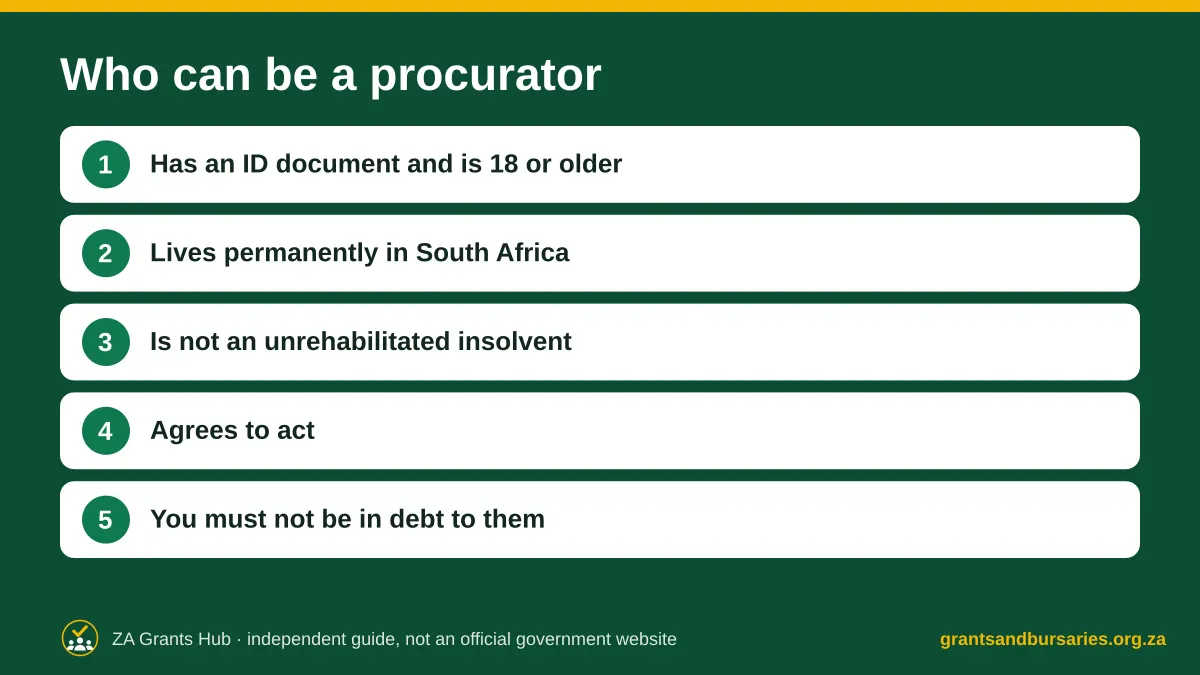
Under the regulations, the person must:
- have an identification document;
- be at least 18 years old;
- live permanently in South Africa;
- not be an unrehabilitated insolvent;
- be willing to act for you.
There is a sixth condition: you must not owe that person money. This protects you from a lender taking control of your grant.
Can your child or spouse be your procurator?
Yes, if they meet the same conditions and are appointed properly. Being family gives no automatic right to collect. A son holding your card without authority is not a procurator.
Can a neighbour or caregiver do it?
They can, if the conditions are met. Think about what happens if you fall out. Choose someone who is reachable, honest and unlikely to move far away.
Can a moneylender or shop owner do it?
Not if you owe them anything. The regulations also forbid ceding, pledging or keeping a grant card to secure a loan or debt. Report anyone who does this.

How many people can one procurator represent?
No more than five. The regulations say a procurator may not receive social assistance on behalf of more than five beneficiaries.
The limit counts beneficiaries, which means people. Family members are not exempted in the wording.
| Situation | Within the limit? |
|---|---|
| A daughter acts for both parents | Yes, two beneficiaries |
| A volunteer acts for five neighbours | Yes, at the maximum |
| The same volunteer adds a sixth | No |
| A person acts for five and an aunt asks | No, the aunt needs someone else |
Ask your chosen person how many others they already act for. If you suspect someone is collecting for many people, report it to SASSA.
Which documents do you need to appoint a procurator?
You need SASSA's power of attorney form, identity documents for both of you and supporting statements.
| Document | Detail from SASSA's booklet |
|---|---|
| Power of attorney form | From a SASSA office, signed and fingerprinted by both people |
| Commissioner of oaths | Must witness it, for example a SASSA official, lawyer, police officer or church minister |
| Identity documents | Certified copies for you and the procurator |
| Life certificate | Shows that you are alive |
| Affidavit | Procurator declares the grant will be handed to you |
| Medical or social worker report | If needed to show why you cannot manage |
| Extra affidavits | If you cannot sign, from two people who know you well |
Take originals too. Ask the office whether anything else is needed locally.
How to appoint a procurator step by step
Speak to SASSA first, so you do not sign the wrong form.
- Phone 0800 60 10 11 or visit a local office and explain why you cannot attend.
- Ask whether you need a procurator or the temporary authorisation.
- Get the form.
- Choose a person who meets the conditions and agrees.
- Collect both IDs and certify copies.
- Get a medical or social worker report if asked.
- Sign and fingerprint the form in front of a commissioner of oaths.
- Complete the affidavit and life certificate.
- Submit everything and ask for a receipt.
- Wait for SASSA to confirm before relying on the arrangement.
Our SASSA offices page helps you find a branch.
Warning: Never sign a blank form. Read every line, or have someone you trust read it to you.
What if you cannot get to any office?
Ask a family member to visit and ask what arrangements exist for a person who is housebound. SASSA's statement on reviews asks people who are medically unable to attend to contact their nearest office. We cannot promise a home visit.
How long does approval take?
We could not confirm an official processing time. Ask when you submit, and plan how you will manage the next payment if the appointment is not ready.
How does collection work once a procurator is approved?
The procurator receives the grant in the way SASSA has arranged and must give it to you. Ask SASSA to explain the payment method before the first payment.
Agree on practical rules between you:
- the day money will be handed over;
- how it will be recorded;
- who keeps statements and slips;
- what expenses, if any, may be paid on your instruction.
A simple notebook signed by both of you after each payment prevents many disputes.
Should the procurator use your bank card and PIN?
Do not hand over a card or PIN informally. SASSA's booklet warns beneficiaries never to share a bank PIN. Ask SASSA and your bank how the approved person should access funds lawfully.
If you have a Postbank card, ask Postbank and SASSA what they require for another person to act. Our page on Where to withdraw SASSA money covers collection points.

What can a procurator do and not do?
A procurator may do the grant tasks covered by the appointment. The money must still serve you.
| May do, where appointed | May not do |
|---|---|
| Apply for a grant for you | Keep your grant as their own |
| Receive your grant | Act for more than five beneficiaries |
| Assist with a review | Use your grant to repay debt to them |
| Give SASSA documents | Continue after you end the appointment |
If you receive a grant for a child, remember the money is for that child's care.
Can a procurator attend a SASSA review for you?
Yes, where the person is properly appointed and you cannot attend. SASSA's statement says an authorised representative may be appointed to act for medically unfit beneficiaries.
Not everyone needs a procurator for a review. If you can attend, go yourself.
| Your situation | What to do |
|---|---|
| You can travel | Attend in person |
| You already have a procurator | Ask them to attend with the notice |
| You are ill and have none | Contact SASSA before the deadline |
| A relative wants to go without authority | Phone SASSA first |
What should the procurator take to a review?
Take the notice, both IDs, proof of the appointment, your bank statements for three months, proof of income and any medical report. Our Grant review guide lists the full set.
What if the appointment cannot be finished before the deadline?
Contact SASSA anyway and record the call or visit. Explain that you cannot attend and ask what it will accept. If payment is already paused, see how to Restore a suspended grant.
Does a procurator need to prove you are still alive?
Yes. The procurator must furnish a life certificate on appointment, and the regulations require life certificates annually when SASSA asks. A government service page also says people paid through a procurator must complete one each year.
If this is missed, payment can be affected. Read about Proof of life.
Can a procurator handle the SRD grant?
Do not assume so. SASSA describes SRD as accessed through online application channels, with face verification and a registered cellphone number.
We could not find an SRD-specific procurator process. If an SRD applicant cannot manage the online steps, ask SASSA what help is allowed. A helper should never control the applicant's phone or bank account without consent.
How to change or end a procurator appointment
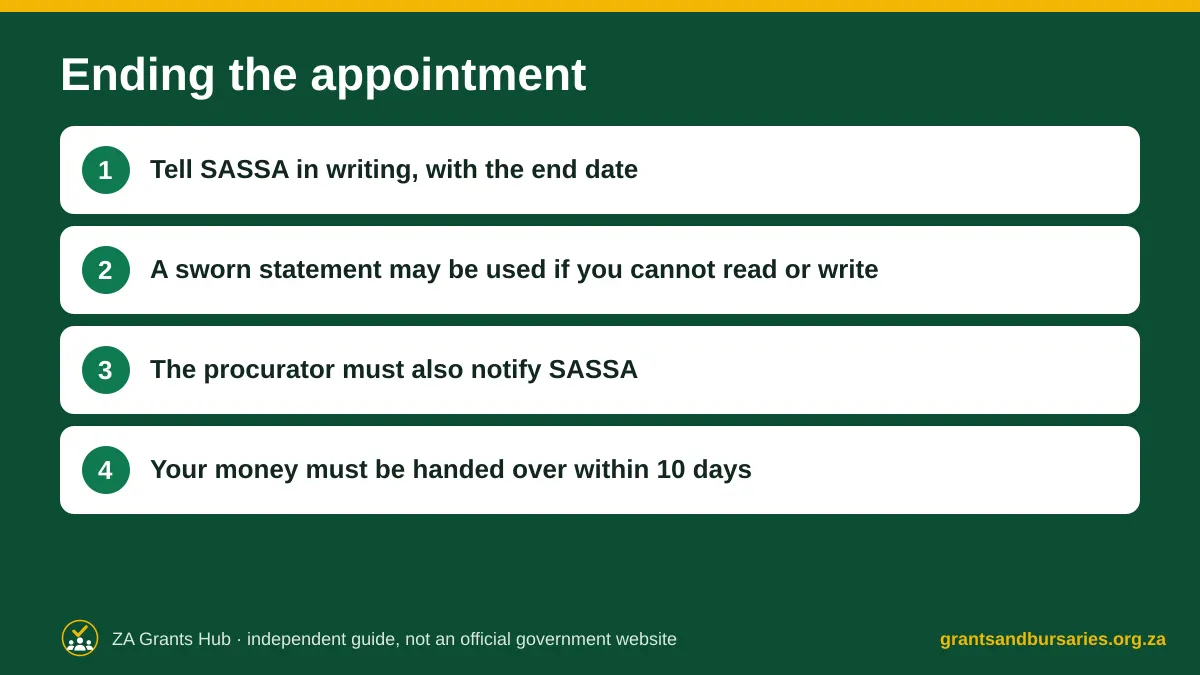
You can end it by notifying SASSA in writing, with the date the termination takes effect. If you cannot read or write, SASSA may take a sworn statement.
- Decide the date the appointment ends.
- Write to SASSA or visit the office.
- Tell the procurator.
- Ask for the money still held and the records.
- Check your payment method on SASSA's system.
- Change PINs through your bank if needed.
- Appoint someone new only after the old appointment is recorded as ended.
The procurator must notify SASSA in writing and transfer any of your money within 10 days of termination. Our guide to Removing or reporting a procurator goes further.
What happens when the beneficiary dies?
The appointment is for a living person. Report the death and do not keep collecting. See Reporting the death of a beneficiary.
How do you choose between collecting yourself and appointing someone?
Collect your own grant if you safely can, and appoint someone only when you need to. Handing over access always carries some risk.
Ask yourself these questions first:
- Could a bank account you control solve the travel problem?
- Is the difficulty temporary, so that three months of help would be enough?
- Do you trust this person with money when you cannot check on them?
- Does another family member know about the arrangement?
- Can you still tell SASSA yourself if something goes wrong?
If you can use a bank card at a nearby shop or ATM with someone walking beside you, you may not need a procurator. They can give you support without ever handling your PIN.
What if you have nobody you trust?
Tell SASSA. The regulations allow the agency to nominate a person where you cannot appoint someone yourself, and SASSA may also use an organisation. Ask for a social worker if you are at risk or being pressured.
What are the warning signs of abuse?
Money that is short, late or unexplained is the main sign. Act early.
- The procurator will not show slips or statements.
- You are not told the payment date.
- Amounts are "borrowed" without your agreement.
- Your card is kept and you are refused access.
- Someone pressures you to sign papers quickly.
Report problems to SASSA on 0800 60 10 11 or the fraud line on 0800 701 701. Theft can also be reported to the police. A trusted person, social worker or advice office can help you make the report.
What should a family agree before appointing someone?
Agree on money, records and what happens if the arrangement stops working. Talking early prevents arguments later.
Write down who buys food and medicine, who pays accounts and who keeps the change. Keep slips in one envelope. If you receive more than one grant, record each amount separately.
Decide who will notify SASSA if you go into hospital or move. See Changes you must report to SASSA. Agree on a backup contact, but remember that the backup has no right to collect unless SASSA appoints them.
You keep the right to decide how your money is used. Nobody in the family gains that right because they carry it to your house.
Tips for choosing and managing a procurator
- Choose reliability over closeness. The nearest relative is not always the safest choice.
- Check for debts. Do not appoint anyone you owe money.
- Ask about other appointments. Confirm they act for fewer than five beneficiaries before adding you.
- Agree on a handover day. Fix when and where money changes hands.
- Record each payment. Both of you sign a notebook entry.
- Keep your own copies. Hold on to the form, receipt and ID copies.
- Review the arrangement. Ask yourself every few months whether it still suits you.
- End it formally. Taking back a card is not enough, so tell SASSA in writing.
- Involve a second person. A trusted relative who sees the records adds protection.
Frequently Asked Questions
What is a SASSA procurator in simple words?
It is a person you officially authorise to apply for or receive your grant when you cannot. You appoint them through a power of attorney and SASSA records it. The money is still yours, and the person must hand it over to you. SASSA, not a private agreement, makes the role official.
How many beneficiaries can one procurator collect for?
The regulations set a maximum of five beneficiaries for one procurator. A relative is not excluded from that wording. Before appointing someone, ask how many people they already act for. If you think a person is collecting for more than five, tell SASSA and give whatever details you have.
Does appointing a procurator cost money?
SASSA does not list a fee in the sources we checked for appointing a procurator. You may pay for transport, copies or a medical report. Be wary of anyone who asks for a share of your grant for acting, or a payment to push the appointment through.
Can my relative collect my grant with my ID and card?
That does not make them a procurator. Without an appointment or temporary authorisation, SASSA has no record of their right to act, and your money is exposed. Ask for the proper form. For short illness, the regulations allow authorisation for up to three consecutive months.
Do I need a lawyer to appoint a procurator?
No, a lawyer is not the only option. SASSA's booklet says the form is signed before a commissioner of oaths, and it gives SASSA officials, police officers, church ministers and lawyers as examples. Take both identity documents and ask your SASSA office to check the papers.
Can a procurator apply for a new grant for me?
Yes, the regulations allow a procurator to apply for or receive social assistance on your behalf when you cannot personally do so or it would cause undue hardship. You still have to meet the grant's conditions. The application needs your own information and documents, not the procurator's.
Can I have a procurator and still manage my own grant?
Talk to SASSA about how your payment is arranged. You remain the beneficiary and can end the appointment. If your health improves and you can collect again, notify SASSA in writing so that its records change. Do not leave an old appointment in place by habit.
What if I cannot sign my name?
SASSA's booklet mentions fingerprints on the form and additional affidavits from two people who know you well where you cannot sign. A commissioner of oaths must be involved. Ask SASSA to explain the process, and make sure someone reads the contents to you before you mark anything.
What if my procurator disappears with the money?
Contact SASSA immediately, end the appointment in writing and report theft to the police. Collect your receipts, payment dates and any messages. SASSA can check the record and advise on the payment method. We cannot promise that lost money will be repaid by SASSA, so act as soon as you notice.
Does a procurator need to be appointed for each grant review?
We found no rule requiring a new appointment for every review. An existing, valid procurator may be able to act, but ask SASSA to confirm the appointment is current on your record. Take the review notice and proof of appointment, plus your own supporting documents.
Can a procurator look after a child grant?
A procurator concerns receiving social assistance for a person who cannot do it themselves. A child grant belongs with the primary caregiver for the child's needs. If the child's carer has changed, that is not a procurator matter, and the new caregiver should speak to SASSA about applying.
Your next step
Phone or visit SASSA, explain why you cannot manage your grant yourself and ask which form fits: procurator or temporary authorisation. Pick a person who meets the conditions and whom you do not owe money. For contact options, see our SASSA contact page.
Sources
- Social Assistance Act regulations, Government Notice R.2119 (2022)
- SASSA: You and Your Grant 2026 booklet
- SASSA statement: beneficiaries identified for review (2026)
- South African Government: old age pension service page

About The Author
Sarah Johnson is an informational writer covering South African social assistance programmes, SASSA grants and public service updates.
Keep Reading