SASSA income verification is the monthly check that looks for money or records suggesting you can support yourself. If it finds income above the means test, that SRD month is declined. Review every deposit for that month, gather proof, and appeal within 90 days if the result is wrong.
Contents (20 topics)
- What is SASSA income verification?
- What is the SRD income threshold?
- How does the monthly bank check work?
- What does "alternative income source identified" mean?
- Can eWallet money affect your SRD grant?
- Does moving your own money count as income?
- How do you fix a SASSA income verification decline?
- How do you appeal an income decline?
- Which documents should you collect?
- What if you really did earn money?
- How do you build a deposit list that makes sense?
- What common mistakes weaken an income appeal?
- What if you cannot go online or get statements easily?
- Can you be approved again after an income decline?
- What other messages can appear during the checks?
- How do you check progress after you appeal?
- How do you stay safe while sorting out an income decline?
- Tips for avoiding surprises from income checks
- Frequently Asked Questions
- Your best next step
What is SASSA income verification?
It is SASSA's test of whether you have insufficient means for the R370 SRD grant. SASSA compares your details with information from banks and government databases.
When you apply, you consent to checks on your details, income and bank accounts. SASSA's 2026 booklet says submitting a social grant application gives that consent. The checks do not stop after your first approval.
SASSA has said that applications may be declined when it finds a source of income through outside databases, including financial institutions.
What does the check look at?
- Money going into bank accounts linked to your ID number
- Records of employment or payments, such as UIF
- Student funding records such as NSFAS
- Other social grants paid to you
SASSA does not publish the full formula it uses. Be careful with websites that claim to know exactly which deposit will be counted.
What is the SRD income threshold?
The published monthly means test is R624. A SASSA statement from July 2025 listed it, and the figure comes from a 2022 change to the SRD regulations.
The threshold is under legal challenge. In January 2025 the High Court in Pretoria ruled against several SRD regulations, including the income threshold and the way income is defined. Government appealed. The Supreme Court of Appeal heard the case in August 2026.
Until you see an official change, treat R624 as the working figure. Check government announcements, because a ruling or new regulations could alter it.
| Item | Current position |
|---|---|
| Grant amount | R370 per month |
| Monthly means test | R624 |
| Funded until | 31 March 2027 under current rules; one more year announced in October 2026 |
| How often tested | Every month |
| Appeal window | 90 days from the monthly outcome |
For other grants, the rules differ. Our Means test guide explains them.
How does the monthly bank check work?
SASSA reassesses you for each month, so money that arrives in one month can affect that month only. The next month is tested again.
- SASSA takes your ID number and application details.
- It checks them against databases and bank information.
- It decides whether you meet the conditions for that period.
- The result appears on your status as pending, approved or declined.
The data used for a month may not match the month on your screen exactly. If you cannot find any money in the declined month, also look at the weeks before it. Do not assume which dates were used.
Tip: take a screenshot of each monthly result on the day you see it.
What does "alternative income source identified" mean?
It means SASSA's check found something suggesting you receive income or support beyond the means test. It is a decline for that month, not a finding that you committed fraud.
The message rarely names the deposit. Common possibilities to check are:
- Wages or piece work paid into your account
- Regular support from a partner, parent or relative
- Money from selling goods or services
- Transfers from your own other accounts
- Money you collected for someone else
- Stokvel payouts
- Loan money
Some of these may count and some may not. The legal definition of income is part of the court case, so explain the facts and let the Tribunal decide.
For other decline wording, see Declined status reasons.
Can eWallet money affect your SRD grant?
It can. Money sent to a phone wallet or collected through a cash-send service may still be money you received, and some records are linked to your identity.
No official SASSA page we found lists which wallet transactions are counted. So treat any incoming amount as something you may need to explain.
Which transfers should you record?
| Money received | What to note | Proof to keep |
|---|---|---|
| Gift from family | Who sent it and why | Their written note, transaction SMS |
| Money held for someone else | Whose it was and where it went | Both transactions, their statement |
| Payment for work or goods | Date, job and amount | Receipts or messages |
| Refund | Who refunded you and for what | Original purchase and refund slip |
| Repaid loan | When you lent and got it back | Messages and both records |
Is a SASSA cash send the same thing?
No. If you collect your own SRD payment by cash send, that is the grant itself. An eWallet from a friend or employer is a separate receipt. Keep the SMS messages so you can show which is which.
Does moving your own money count as income?
Moving money between your own accounts is not new income in the ordinary sense. An automated check, or a statement read on its own, may still show it as a deposit.
How to identify your own transfers
- Get statements for every account in your name.
- Find each incoming amount for the month.
- Look for a matching outgoing amount from your other account.
- Compare date, amount and reference.
- Highlight both sides and number each pair.
A transfer from savings is the same money moving, provided you can show where the savings came from. If the savings were earned during the same period, explain that honestly.
What proof shows a transfer was yours?
Two statements that show your name and matching entries are the strongest simple proof. A bank letter can help if references are unclear. A screenshot without your name is weak.
Warning: never send statements to private "appeal helpers". We are not SASSA and will never ask you for banking details.
How do you fix a SASSA income verification decline?
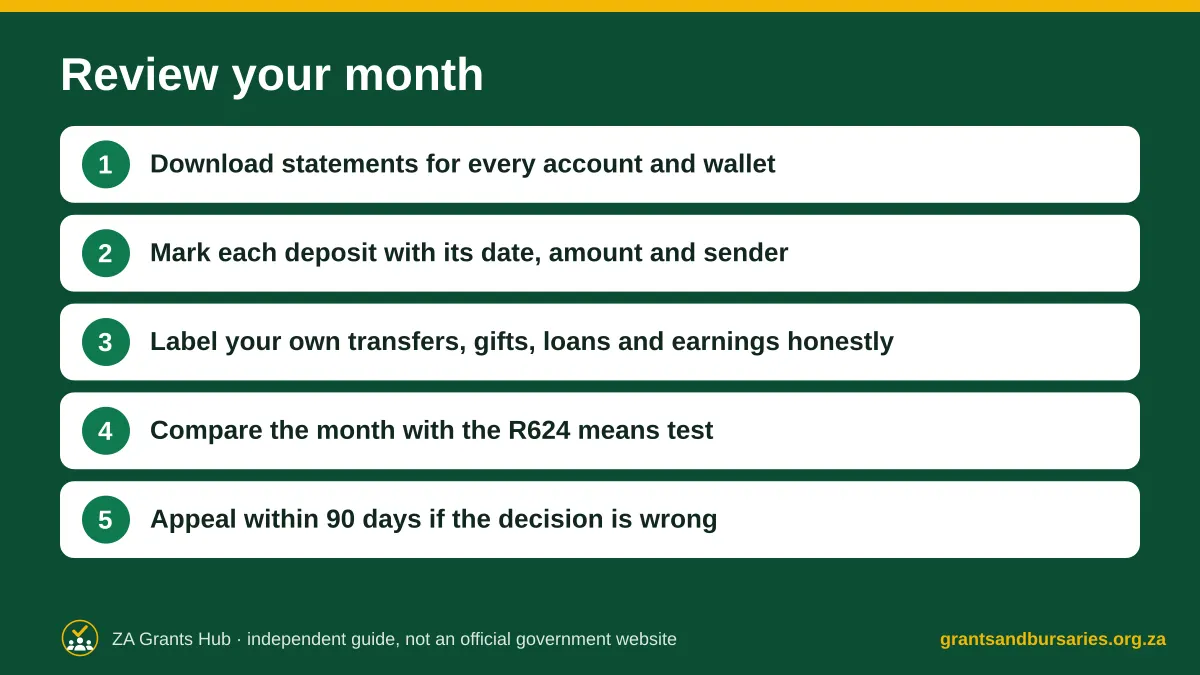
Find the money, label it, then appeal the month. Fix any wrong database record at the source.
- Check the exact reason for each month on srd.sassa.gov.za.
- List your accounts, including old and unused ones.
- Download statements from your bank app, branch or ATM service.
- Make a deposit list with date, amount, sender and reason.
- Gather proof for anything that was not your income.
- Lodge the appeal within 90 days.
- Save the confirmation and check progress later.
If you do not recognise an account, ask the bank at once. Someone may have opened or used it with your details.
How do you appeal an income decline?
Use the online appeals platform at srd.sassa.gov.za/appeals or srd.dsd.gov.za. The Independent Tribunal for Social Assistance Appeals decides each month separately.
Choose the month, give your reason and explain the money in short sentences. For example: "R900 on 4 May was money my cousin sent for her child's school shoes. I paid it to the shop the same day."
Only write what is true and what you can show. SASSA's appeals page says the Tribunal aims to finalise within 60 to 90 days of receiving an appeal. A successful result applies to the month you appealed.
Step-by-step screens are in How to appeal. Later results are explained on Appeal outcome.
Which documents should you collect?
Collect documents that explain the money for the declined month. Quality matters more than a large pile.
- Statements for all accounts for the relevant weeks
- Wallet or cash-send messages
- A written note or affidavit from the person who sent money
- Proof that a job ended, such as a letter or final payslip
- UIF or NSFAS confirmation if those appear
- Screenshots of your SRD status
An affidavit is a sworn statement signed before a commissioner of oaths, such as at a police station. It supports your explanation, but it does not guarantee success. If your decline names UIF, use our UIF decline guide.
What if you really did earn money?
Be honest. If your income was above the limit for that period, you did not qualify for that month.
You may qualify again when your income drops, because each month is assessed separately. Keep your record up to date and report real changes in your circumstances. SASSA says beneficiaries must tell it about changes to their financial position.
Hiding income carries risk. The 2024 amendment to the SRD regulations allows the Agency to recover money paid to a person who was not entitled to it.
How do you build a deposit list that makes sense?
Put every incoming amount for the period into one simple table, in date order. A reader should understand your month in a minute.
Copy the layout below onto paper. The entries are examples of the format only.
| Date | Amount | From | What it was | Proof number |
|---|---|---|---|---|
| Day and month | Rand value | Your other account | Own transfer | 1 |
| Day and month | Rand value | Person's name | Gift for a stated purpose | 2 |
| Day and month | Rand value | Name or business | Payment for work | 3 |
- Start with the first statement and move line by line.
- Include small amounts, because several can add up.
- Write the purpose in plain words.
- Number each proof and write the same number on the document.
- Mark anything you cannot explain, then ask your bank about it.
Do not leave out a deposit because it looks bad. If SASSA already holds information about it, a missing line weakens the rest of your account.
What common mistakes weaken an income appeal?
Most weak appeals are too vague or do not match the declined month. Check yours against these points before you submit.
- Saying only "I have no income" when deposits are visible
- Sending statements for the wrong month
- Covering one account while another holds the money
- Cropping a screenshot so that your name is missing
- Writing a story that does not match the dates on the statement
- Waiting for perfect proof until the 90 days have passed
A good appeal is short and honest. Name the month, explain each amount and say what you attached or can show.
What if you cannot go online or get statements easily?
Ask for help early, because the deadline keeps running. A SASSA office can explain your status and how to lodge an appeal.
Take your ID, your registered phone and any bank records you already have. At the bank, ask for a statement that covers the declined month and the weeks before it. Ask about the fee before they print.
You can also phone SASSA on 0800 60 10 11 or email [email protected]. Never email your PIN or online banking password to anyone. A relative may help you type, but keep your documents and one-time codes in your own hands.
Can you be approved again after an income decline?
Yes, a later month can be approved if you meet the conditions then. You do not need to start a new application just because one month was declined.
Check the portal for any instruction on your record. Keep your phone number and banking details correct. If later months show pending, read What pending means.
What if the same decline repeats every month?
Look for something regular: a monthly transfer, an old employer record, or support from someone else. Appeal each month while you investigate. Ask SASSA on 0800 60 10 11 what you can do about a record you believe is wrong.
What other messages can appear during the checks?
Not every blocked month is about money, so read the wording before you collect statements.
| Message | Is it about income? | Where to go next |
|---|---|---|
| Pending | Not decided yet | Wait and check again later |
| Bank details pending | No, details are missing | Submit your banking details |
| Identity verification failed | No, identity is unconfirmed | Verify again or visit an office |
| Alternative income source identified | Yes | Review deposits and appeal |
| UIF registered | A database match | Ask the UIF what it holds |
| NSFAS registered | Student funding match | Confirm your NSFAS status |
If your month is stuck on identity, our Biometric verification guide explains the face check.
How do you check progress after you appeal?
Return to the appeals platform and look up each month you lodged. Keep your own list so that none is forgotten.
For every appeal, write down the month, the date you submitted, the reason you chose and what proof you hold. Check again from time to time, not only once. If the status does not move for a long period, phone SASSA and quote your submission date.
Keep checking new months on the normal status page as well. An open appeal does not stop SASSA from assessing later periods. If a new month is declined for income, it needs its own appeal within its own 90 days.
While you wait, do not close accounts or delete messages that support your case. You may need to show them again. Do not plan household spending around money from an appeal, because the outcome is not certain.
How do you stay safe while sorting out an income decline?
Share documents only through official channels. People waiting for money are a common target.
Never pay a person to "clear" your income record. Never send your online banking password, card number or one-time code. A real official does not need them to hear your case. If someone offers to submit appeals for you for a fee, refuse. The platform is free to use.
Tips for avoiding surprises from income checks
- Know your accounts. List every bank account and wallet linked to your ID.
- Do not lend your account. Money passing through for a friend can look like yours.
- Use clear references. Ask senders to write what the money is for.
- Save statements monthly. Old transactions can become harder and costlier to get.
- Keep your own transfers tidy. Move money only when you need to, and note why.
- Report real changes. A new job or regular income must be declared.
- Appeal each month. One appeal does not cover the next.
- Protect your ID. Someone else could open accounts in your name.
- Ignore paid shortcuts. No agent can switch off an income check.
Frequently Asked Questions
How does SASSA verify my income?
SASSA checks your details against bank information and government databases each month. You consent to these checks when you apply. If the results suggest you have income or support above the means test, the month can be declined. SASSA does not publish every detail of the method, so review your own accounts carefully.
What is the income limit for the R370 grant?
The published monthly means test is R624. It is part of a court case: the High Court ruled against the threshold in January 2025, and government appealed to the Supreme Court of Appeal. Unless an official change is announced, work with R624 and check government sources for updates.
Does one deposit disqualify me for ever?
No. SASSA assesses each month separately. A deposit that affects one month does not automatically block later months. Check each result. If you think a declined month was wrong, appeal it within 90 days. If it was right, watch the following months, which are tested on their own information.
Can money from my child's father affect my SRD?
It can, if the check treats it as financial support to you. Record the amount, date and purpose, and keep proof of how it was used. The definition of income is under legal challenge. State the facts truthfully in an appeal, without assuming that money for a child will be ignored.
Do Child Support Grants count as my income?
A Child Support Grant is paid for the child. If your decline seems to rest only on that grant, ask SASSA to explain and consider appealing. A grant paid in your own name for yourself, such as a disability grant, is different and prevents you from receiving SRD.
Can SASSA see my bank account?
Your application gives SASSA consent to verify information including bank accounts and income. That does not mean staff may ask for your PIN. They should never do so. Keep your PIN and one-time codes private, and use only official SASSA and bank channels for any query.
What proof do I need for my own transfer?
Provide statements from both accounts showing your name, matching amounts and close dates. Mark the two entries clearly and explain where the money first came from. A bank letter can help when references are unclear. Keep your originals and submit only through the official appeal channel.
How long do I have to appeal an income decline?
You have up to 90 days from the monthly outcome. The appeals page also mentions a 30-day point within that period, so do it early. Submit one appeal per declined month. You can keep collecting proof, but do not miss the deadline while waiting for documents.
What if I do not have a bank statement?
Ask your bank for one at a branch, through its app or by other channels it offers. Fees may apply. For wallets, save transaction messages and request a history from the provider. If you cannot get a record in time, lodge the appeal and explain what you requested.
Will SASSA ask me to repay money?
Recovery is possible when a person was not entitled to the SRD grant, under the 2024 amendment to the regulations. It does not follow from every query. If SASSA contacts you about money owed, ask for the reasons in writing and get advice before you agree to anything.
Your best next step
Download statements for all your accounts for the declined month and write one line for every deposit. Then lodge the appeal with that list while you are still inside 90 days. For help reading your result first, use the SRD status check guide.
Sources
- SASSA clarifies review of social grants, SRD means test (gov.za)
- You and Your Grant 2026 booklet (SASSA)
- Amendment Regulations on COVID-19 SRD, 2024 (gov.za)
- SASSA beneficiaries and biometric verification, income checks (SAnews)
- Parliamentary reply NW3195 on database checks (PMG)

About The Author
Sarah Johnson is an informational writer covering South African social assistance programmes, SASSA grants and public service updates.
Keep Reading