The child support grant top up is an extra monthly amount for relatives who care for orphaned children. In 2026 it is R290 on top of the R580 grant, so R870 per qualifying child. Apply at any SASSA office with your ID, the child's birth certificate and proof that the parents have died.
Contents (12 topics)
- What is the child support grant top up?
- How much is the top up in 2026?
- Who qualifies for the top up?
- Which documents do you need?
- How do you apply for the top up?
- What happens after you apply?
- Is the top up the same as a foster child grant?
- Why might the application be refused or delayed?
- When does the top up stop?
- Tips for a smooth top up application
- Frequently Asked Questions
- Your next step
What is the child support grant top up?
It is an additional payment linked to a child support grant, not a separate grant. The child must already receive the grant, or you apply for both together.
The government introduced it in June 2022. Its purpose is to help relatives who raise orphans without going through a court placement first. The ordinary Child support grant rules still sit underneath it.
How much is the top up in 2026?
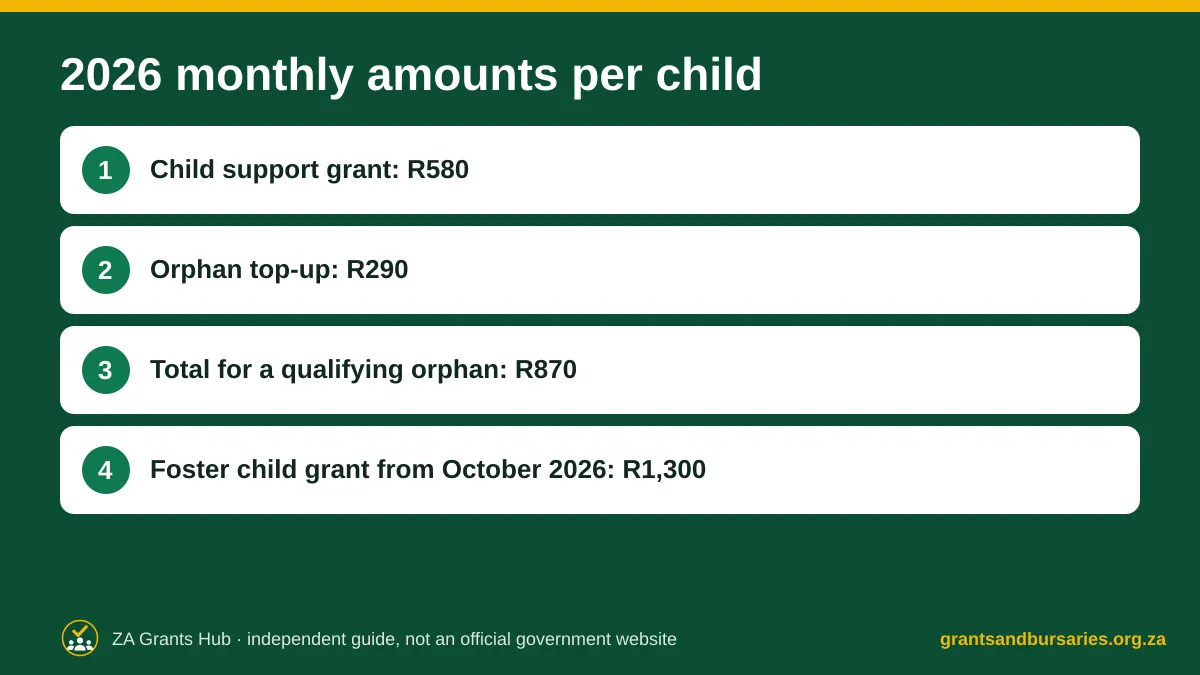
The top-up is R290 a month for each qualifying child. It rose from R280 in April 2026.
| Payment | Monthly amount |
|---|---|
| Child support grant | R580 |
| Orphan top-up | R290 |
| Combined for one qualifying orphan | R870 |
| Combined for two qualifying orphans | R1,740 |
| Combined for three qualifying orphans | R2,610 |
These figures come from the Government Gazette notice dated 23 March 2026. Amounts change from time to time. Check our Grant amounts page before you budget.
Who qualifies for the top up?
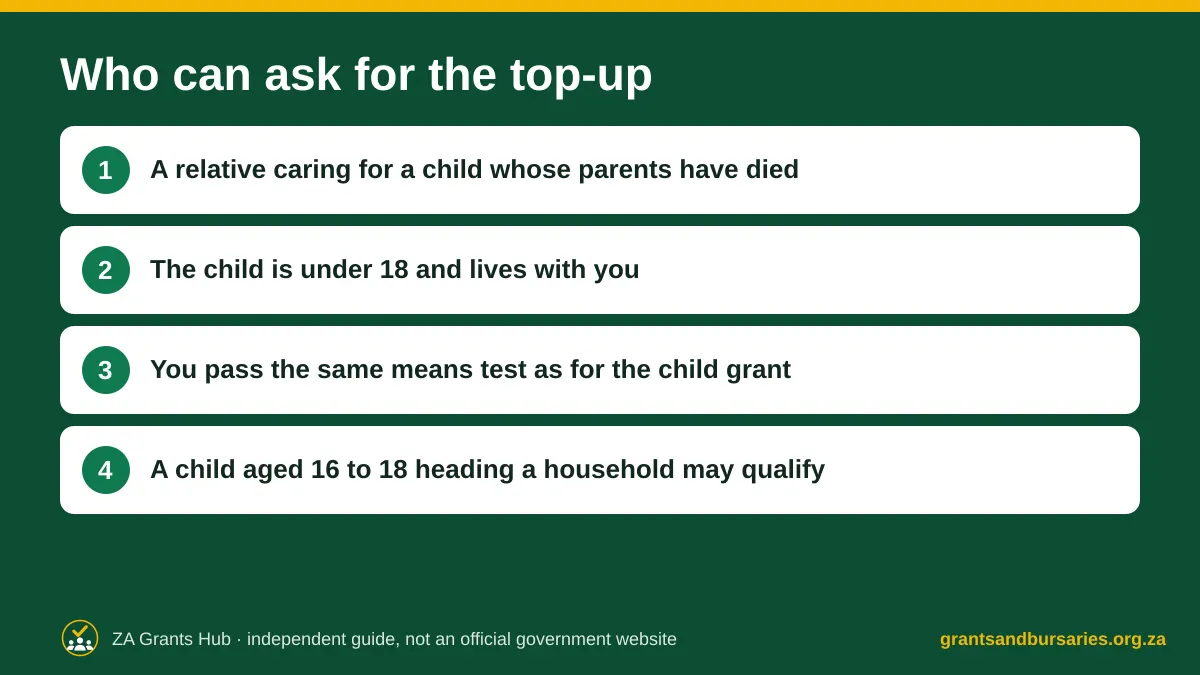
You need to be a relative caring for an orphan, and you must meet the grant rules. The regulations count grandparents, brothers and sisters as relatives, and the SASSA booklet also names uncles, aunts and cousins.
The booklet lists these conditions:
- You are a South African citizen, permanent resident or recognised refugee living in the country.
- You are the child's primary caregiver and live with the child.
- The child is under 18 and not permanently cared for in a state-funded institution.
- You meet the means test, together with your spouse if married.
- You apply for no more than six children.
A child aged 16 to 18 who heads a household may also qualify. SAnews reported that such children first see a social worker, who completes a form.
What counts as an orphan here?
The usual proof is death certificates for both parents. A child with one living parent does not fit this description just because that parent is absent.
If you have only one death certificate and the other parent's status is unknown, you can add an affidavit. The regulations say it must be in the format SASSA prescribes.
Which documents do you need?
Take the standard child grant documents plus the death proof.
| Document | Note |
|---|---|
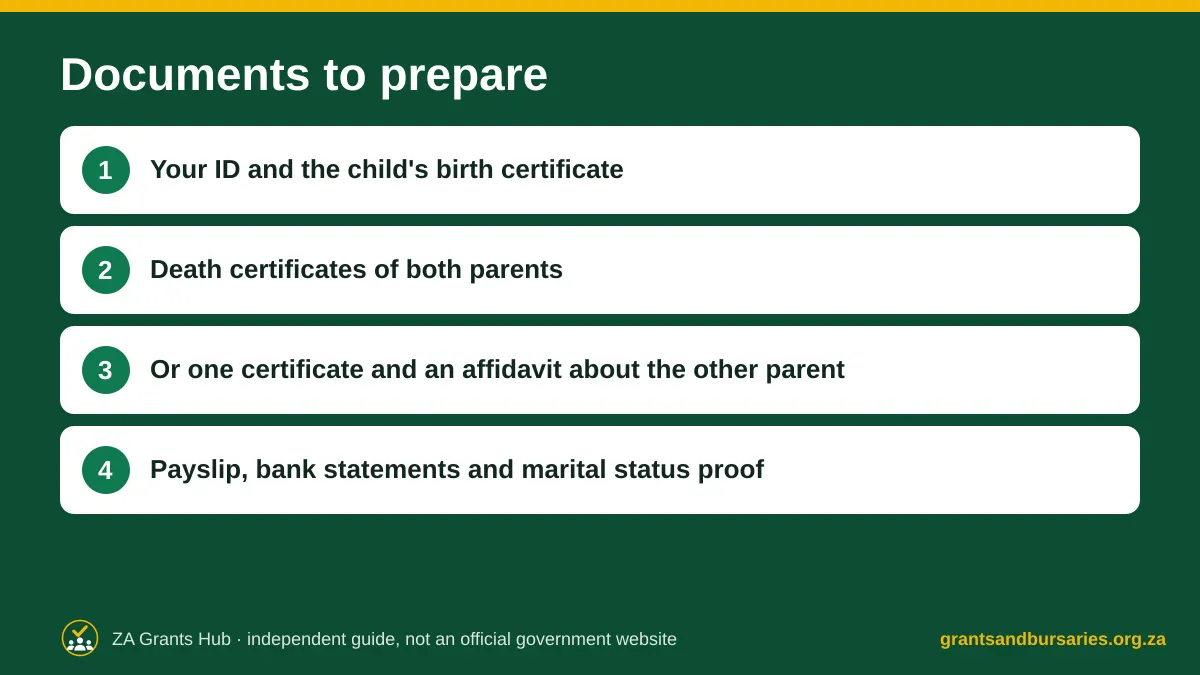
| Your 13-digit ID | Certified copy; add your spouse's if married |
| Child's birth certificate | Certified copy with the ID number |
| Both parents' death certificates | Or one certificate with the affidavit |
| Latest payslip | Not older than three months, for you and your spouse |
| Bank statements | Three months for active accounts |
| Proof of marital status | For example, a marriage certificate or divorce decree |
| School proof | For a child aged 7 to 18 |
| Refugee permit | Only if you apply as a refugee |
Missing school proof alone will not lead to a refusal, according to the booklet. SASSA may ask for other papers at screening.
How do you apply for the top up?
Apply in person at a SASSA office. There is no fee.
- Collect your documents using the table above.
- Visit a SASSA office near where you and the child live.
- Say clearly that you want the orphan top-up linked to the child support grant.
- Complete the forms with the official.
- Check the details before you sign.
- Take your receipt and keep it safe.
- Wait for the result and answer any request for more proof.
Our SASSA offices guide helps you find a branch. If you already receive the child grant for this child, say so at the start. Do not assume the extra amount will be added on its own.
Warning: Nobody needs your PIN to add a top-up. Ignore messages that ask for a fee or a code to "activate" it.
What happens after you apply?
SASSA checks your documents and income, then tells you the outcome. The regulations allow up to three months for a decision.
After approving the top-up, SASSA must refer you and the child to the provincial Department of Social Development. A social worker may assess whether the family needs support or whether the child needs care and protection. This is part of the rules and does not mean you did something wrong.
When approved, grants are generally paid from the application date. Confirm your own start date with SASSA and check the Payment date page.
Is the top up the same as a foster child grant?
No. A foster child grant needs a court order, while the top-up does not need one.
| Feature | Child grant with top-up | Foster child grant |
|---|---|---|
| Monthly amount | R870 | R1,300 from October 2026 |
| Court order | Not required | Required |
| Means test | Yes | No |
| Who it suits | Relative caring for an orphan | Child placed in foster care by a court |
| Where to start | SASSA office | Social worker and Children's Court |
You cannot assume you may receive both for the same child. A caregiver already receiving another grant for that child does not qualify for a new child support grant. Ask a social worker which route fits. Read about the Foster child grant.
Why might the application be refused or delayed?
Most problems come from proof or income. Check these before you apply.
- A parent's death was never registered with Home Affairs.
- Names or ID numbers differ between documents.
- The affidavit about the missing parent is not in the right format.
- Household income is above the limit.
- Another person also claims to care for the child.
- Someone still receives the grant for the same child.
If a previous caregiver died, see What happens when a caregiver dies. If someone else is still collecting, tell SASSA.
If you are refused, ask for the written reason. You may appeal to the Independent Tribunal for Social Assistance Appeals, generally within 90 days of the decision.
When does the top up stop?
It depends on the child support grant, so it ends when that grant ends. The usual date is the end of the month in which the child turns 18.
It can also stop if the child dies, leaves your care or you no longer qualify. Report these events promptly, using our list of Changes to report to SASSA. If payment pauses after a review, see How to restore a suspended grant.
Tips for a smooth top up application
Preparation saves repeat trips.
- Register deaths first. Home Affairs certificates are the core proof.
- Ask for the top-up by name. Staff need to know you want more than the basic grant.
- Take originals too. Officials may want to compare copies.
- Certify in advance. Ask which copies need a Commissioner of Oaths stamp.
- Explain the family link. Birth records can show how you are related to the child.
- Keep your receipt. It proves your application date.
- Update your phone number. The outcome may arrive by message.
- Tell the truth about income. False information can end the grant and create a debt.
- Welcome the social worker. The referral can open other support for the child.
Frequently Asked Questions
How much is the child support grant top up?
The top-up is R290 a month per qualifying orphan in 2026, added to the R580 child support grant. That makes R870 for each such child. The March 2026 gazette notice shows the top-up moving from R280 to R290 in April. Confirm current figures with SASSA when you apply.
Who can apply for the top up?
A relative who is the primary caregiver of an orphaned child can apply, if they meet the child grant rules and means test. This includes grandparents and older siblings. A child aged 16 to 18 who heads a household may also qualify. Strangers to the family do not fall under this payment.
Do I need a court order?
No court order is needed for the orphan top-up. You do need proof that the child's parents have died, usually both death certificates. A court order is needed for the foster child grant, which is a different payment. A social worker can help you decide which route suits the child.
Can I get the top up if one parent is alive?
The top-up is meant for orphans. If one parent is known to be alive, the child will not normally qualify. If the status of the other parent is truly unknown, the regulations allow one death certificate plus a prescribed affidavit. Tell SASSA the facts honestly and ask what it accepts.
Is the top up paid automatically?
Do not expect it to appear on its own. You need to show that you are a relative and that the child is an orphan. Visit a SASSA office, ask for the top-up and submit your proof. This applies even if you already receive the ordinary child grant for the child.
How long does approval take?
SASSA should notify you of the outcome within three months of the application date. It may be quicker. Delays often happen when a certificate is missing or details do not match. Keep your receipt, respond to requests and phone 0800 60 10 11 if you have heard nothing.
Can I apply online?
We could not confirm an online route for the top-up. The government's announcement told relatives to apply at SASSA offices. Check services.sassa.gov.za or phone SASSA before you travel, in case options have changed. Take original documents and copies so that you can finish in one visit.
How many children can receive it?
The SASSA booklet says you may not apply for more than six children under the top-up criteria. Each child needs a birth certificate and proof of the parents' deaths. The means test and care rules apply too. Ask SASSA how your other children or grants affect the application.
Does the top up affect my own SRD or old age grant?
A child support grant is received for the child, not as your own income support. Older people often receive it for grandchildren. The SRD grant has its own eligibility checks, so ask SASSA how your situation is treated. Always declare all grants you receive when you apply.
What if the child already gets a foster child grant?
Do not apply for the top-up as an extra for the same child. The two routes are separate, and a child should not draw both. If you are changing from one arrangement to the other, speak to a social worker and SASSA first, so payments do not overlap or stop.
Your next step
Get both death certificates and the child's birth certificate together. Then visit a SASSA office and ask for the orphan top-up by name, keeping the receipt as proof of your date.
Sources
- Government Notice R7287: increase in social grants, 23 March 2026
- Social Assistance Regulations, 31 May 2022 (Government Notice R2119)
- SASSA booklet: You and Your Grant 2026
- SAnews: Child Support Grant Top-Up available at all SASSA offices

About The Author
Sarah Johnson is an informational writer covering South African social assistance programmes, SASSA grants and public service updates.
Keep Reading